

By Earle Philhower, Marketing Manager for AMI MegaRAC® Manageability Solutions, AMI
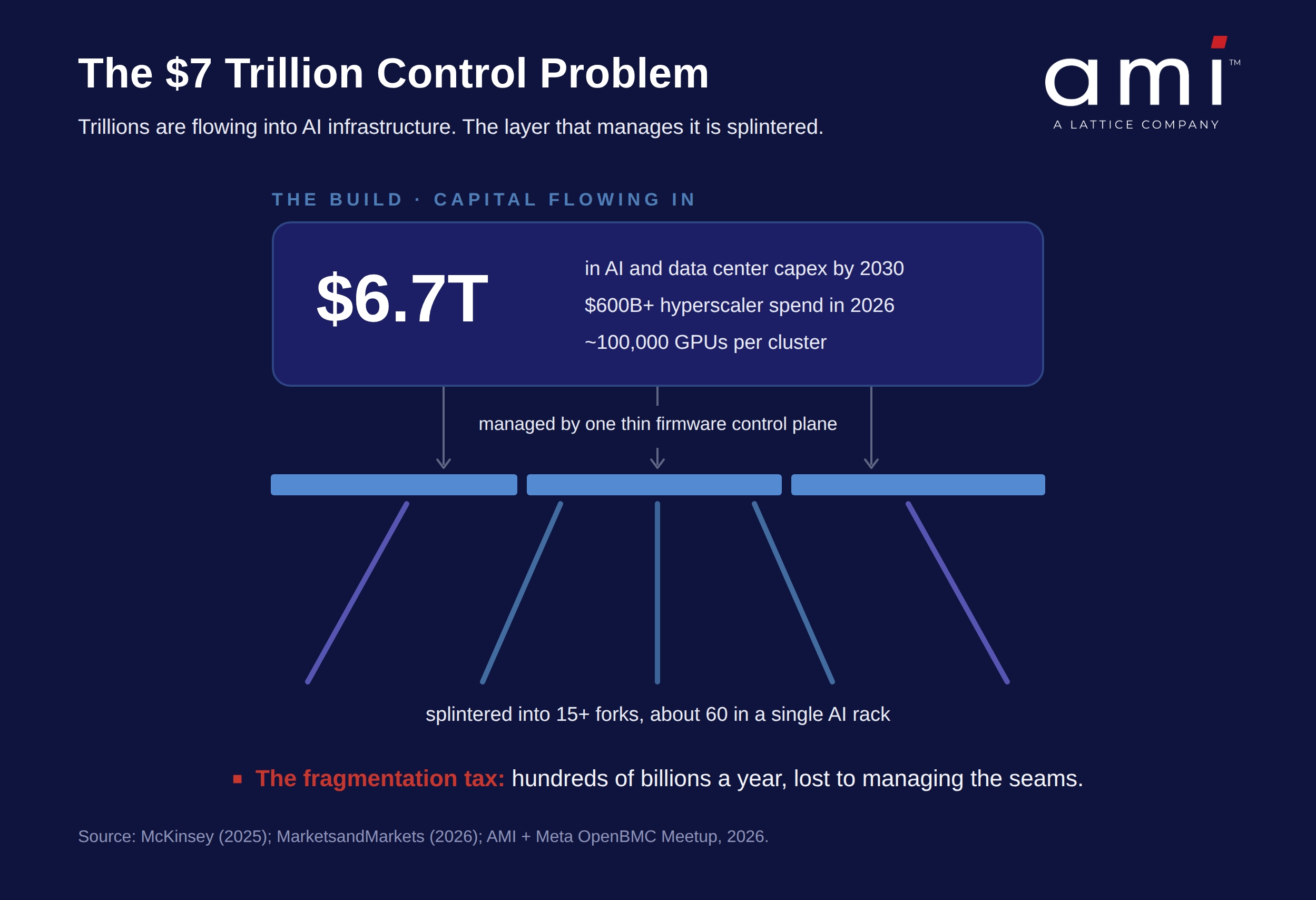
The AI buildout is the largest infrastructure project in modern history. McKinsey puts cumulative data center capital spending near $6.7 trillion by 2030. The five biggest cloud companies alone are on track to spend more than $600 billion in 2026. Of that total, McKinsey ties about $5.2 trillion to AI-specific infrastructure, and analysts estimate roughly three quarters of hyperscaler spending in 2026, on the order of $450 billion, is aimed at AI, up more than a third in a single year.
The market for AI data centers is forecast to climb from about $470 billion in 2026 to roughly $2 trillion by 2032. Almost all of the attention goes to the visible parts: the chips, the power, the buildings. The piece that rarely makes the business case is the one that decides whether any of it can be run at scale.
Every server in every cluster carries one or more baseboard management controllers, or BMCs. A BMC is not just firmware. It is a combination of dedicated hardware and firmware, a small and unglamorous computer in its own right, built to manage the machine around it. It reports telemetry, manages power and thermal behavior, enforces security policy, and keeps an operator in command of hardware they may never physically touch. The count climbs fast in AI systems: a single board can carry more than one, and NICs and accelerators like NVIDIA’s ConnectX-9 increasingly ship with their own onboard BMC, in addition to those on the motherboard.
For most of the industry’s history, that layer was background plumbing. At the scale AI now demands, it has become the control plane for the entire AI data center, and the place where fleet-wide visibility and security either hold together or fall apart.
The pressure on that layer is climbing as fast as the spending. Training racks that once drew a handful of kilowatts now pull 100 to 200 and more. Single clusters pass 100,000 GPUs. Power and cooling are climbing on the same curve, with electrical and thermal systems for AI data centers projected near $720 billion a year through the end of the decade and global data center electricity use on track to cross 1,000 terawatt-hours.
The cost of failure has climbed with the price tag. A $10,000 server going dark was a nuisance. A $2.5 million NVIDIA system going dark burns money every minute it stays down, in lost revenue and idle capacity. The math only works if the management layer scales as cleanly as the compute, and right now it does not.
The Control Plane is Splintered
The control plane that manages all of it is splintered. OpenBMC™, the open-source BMC firmware project originated by the Linux Foundation that most of the industry relies on, has been adapted into dozens of separate vendor versions, each tuned to particular silicon and maintained on its own schedule. The effect is visible inside a single rack. By one project maintainer’s count, a high-end AI rack can run roughly 60 different builds of that same firmware at once. Spread that across a fleet of hundreds of thousands of nodes, and the management layer starts to look less like infrastructure and more like a patchwork an operator has to hold together by hand.
That patchwork carries a price. Every operator and hardware vendor repeats the same cycle: porting firmware, validating it, hardening it, and certifying it again for each new platform, and maintaining it with security and bug fixes across a multi-year deployment lifetime. Telemetry arrives in mismatched formats. Security fixes land at different speeds across versions, which widens the attack surface. Research on data center operations points to efficiency losses and higher total cost of ownership across fragmented stacks. If management overhead runs even 10% to 15%, a conservative assumption, that’s hundreds of billions of dollars on a $2-trillion-a-year market. At even 10% to 15%, management overhead on a $2-trillion-a-year market wastes hundreds of billions of dollars.
The Industry Has Been Here Before
The pattern is familiar. Railroads overbuilt incompatible gauges before standardization unlocked real network economics. Telecom operators poured capital into long haul fiber before interconnect and operational standards caught up, leaving capacity dark for years. Early server farms faced similar friction until virtualization and standardized operating system distributions made large scale utilization and management viable. AI infrastructure is at the same inflection point: capital is scaling faster than the control plane is standardizing. Operators end up spending a growing share of their budgets managing the fragile interconnections between systems rather than running the systems themselves.
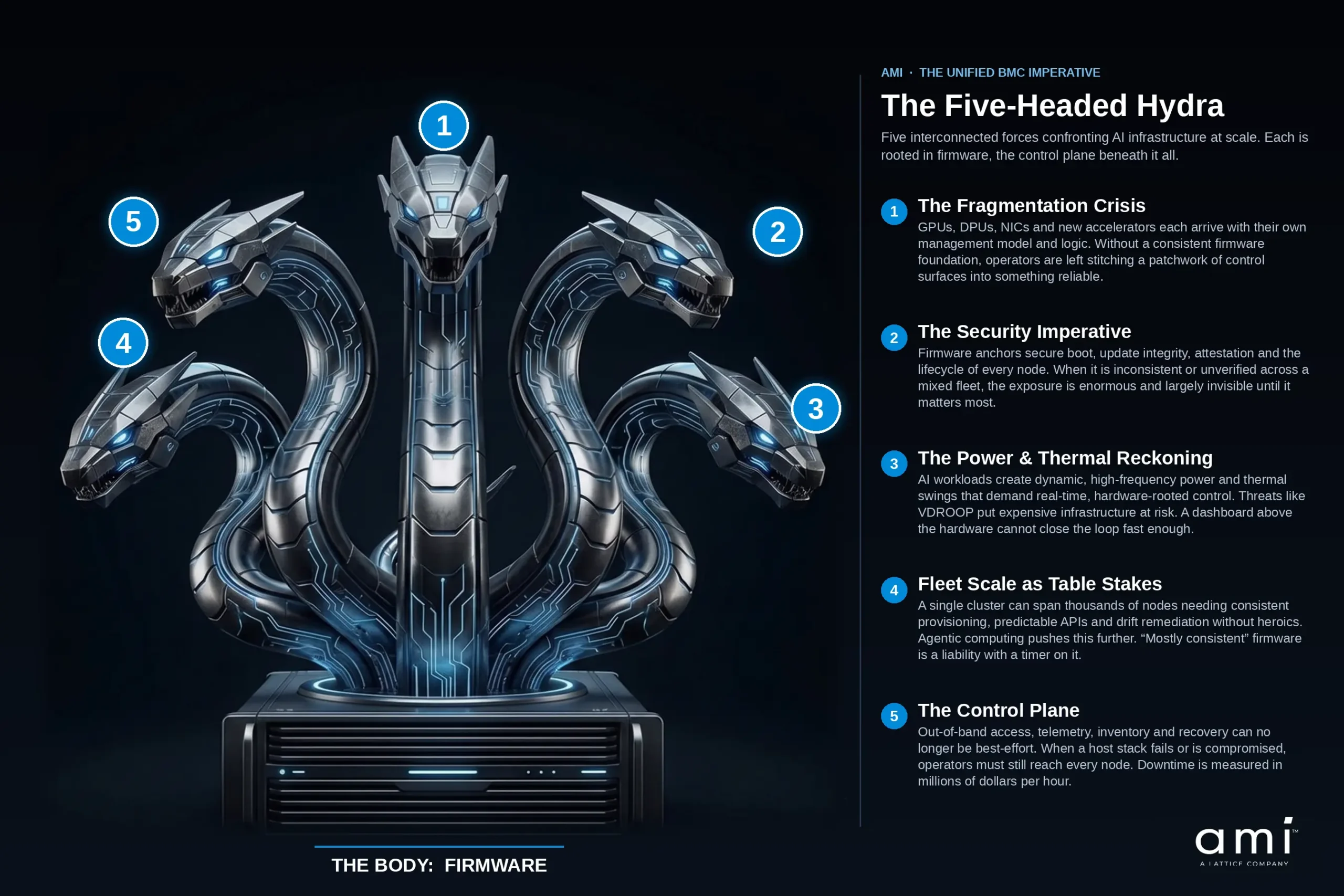
AMI SVP Sanjoy Maity has a useful name for what operators are up against at this layer. In today’s AI data centers, operators face what he calls a “five headed hydra” of control plane risk—fragmentation, security gaps, power and thermal volatility, fleet scale inconsistency, and uneven recovery—and a unified BMC firmware foundation is the tool to cut all five heads at once.
A Distribution, Not Another Fork
The way out is a single, open, production-ready BMC foundation that works across many vendors and hardware generations while still leaving each player room to differentiate. The software industry already proved the pattern. A shared core, with stable and supportable distributions built on top, gave the world dependable operating systems without forcing everyone onto the same branch. The BMC ecosystem is ready for that same discipline, and the timing is right. A major new OpenBMC release from AMI, MegaRAC OneTree Community Edition, arrived this spring, and earlier this year, ecosystem partners gathered at the first OpenBMC Meetup, hosted by AMI and Meta, an event dedicated to working the problem in the open.
AMI contributes upstream instead of forking off to the side. Other vendors talk openness while quietly steering customers toward a version they control. Over time, the code settles it: watch how much a company keeps sending upstream once that stops being the easy path, and you see who meant it.
The Open Question
The capital is committed. The hardware is shipping. The open question is whether the industry standardizes the layer that manages all of it, or keeps paying a fragmentation tax it can no longer afford. For the full architecture and economic case, read our companion paper, “One Code Base, Many Platforms: Why the AI Era Demands a Unified BMC.” It answers how the OpenBMC ecosystem can converge on a unified model.
Sources
- McKinsey & Company, “The cost of compute: A $7 trillion race to scale data centers” (2025), and “Who’s funding the AI data center boom?” (2025).
- McKinsey & Company, “Beyond compute: Infrastructure that powers and cools AI data centers” (2025).
- MarketsandMarkets, “AI Data Center Market worth $2,023.52 billion by 2032” (March 2026).
- MUFG Americas, “AI Chart Weekly: Financing the AI Supercycle” (December 19, 2025), citing CreditSights.
- International Energy Agency, “Energy and AI” (April 2025)
- Rimini Street / Censuswide, “CIOs and CTOs Struggle with Multiple Vendor-Based Support and Services Model” (October 2023).
- Lee et al., “Empirical Study on BMC Firmware Vulnerabilities,” IEEE ICOIN 2026.
- Jessie Frazelle, “Open-source Firmware,” ACM Queue 17(3), 2019.
- “Rearchitecting Datacenter Lifecycle for AI: A TCO-Driven Framework,” arXiv:2509.26534 (September 2025).
- Linux Foundation, “Linux Foundation Research Finds Collaboration, Alignment Key to Managing Fragmentation in Open Source”
- AMI, “AMI Accelerates AI Factory Command and Control with New MegaRAC OneTree Community Edition” (April 2026).
- AMI and Meta inaugural OpenBMC Meetup, Menlo Park, May 2026. Primary source for all attributed speaker quotes: Ed Tanous (NVIDIA), Patrick Williams (Meta), Zachary Bobroff (AMI), Thirupathaiah Annapureddy (Microsoft), Nirav Shah (Intel), Hila Miranda-Kuzy (Nuvoton), Avinash Natarajan (Celestica), Winston Thangapandian (AMI).