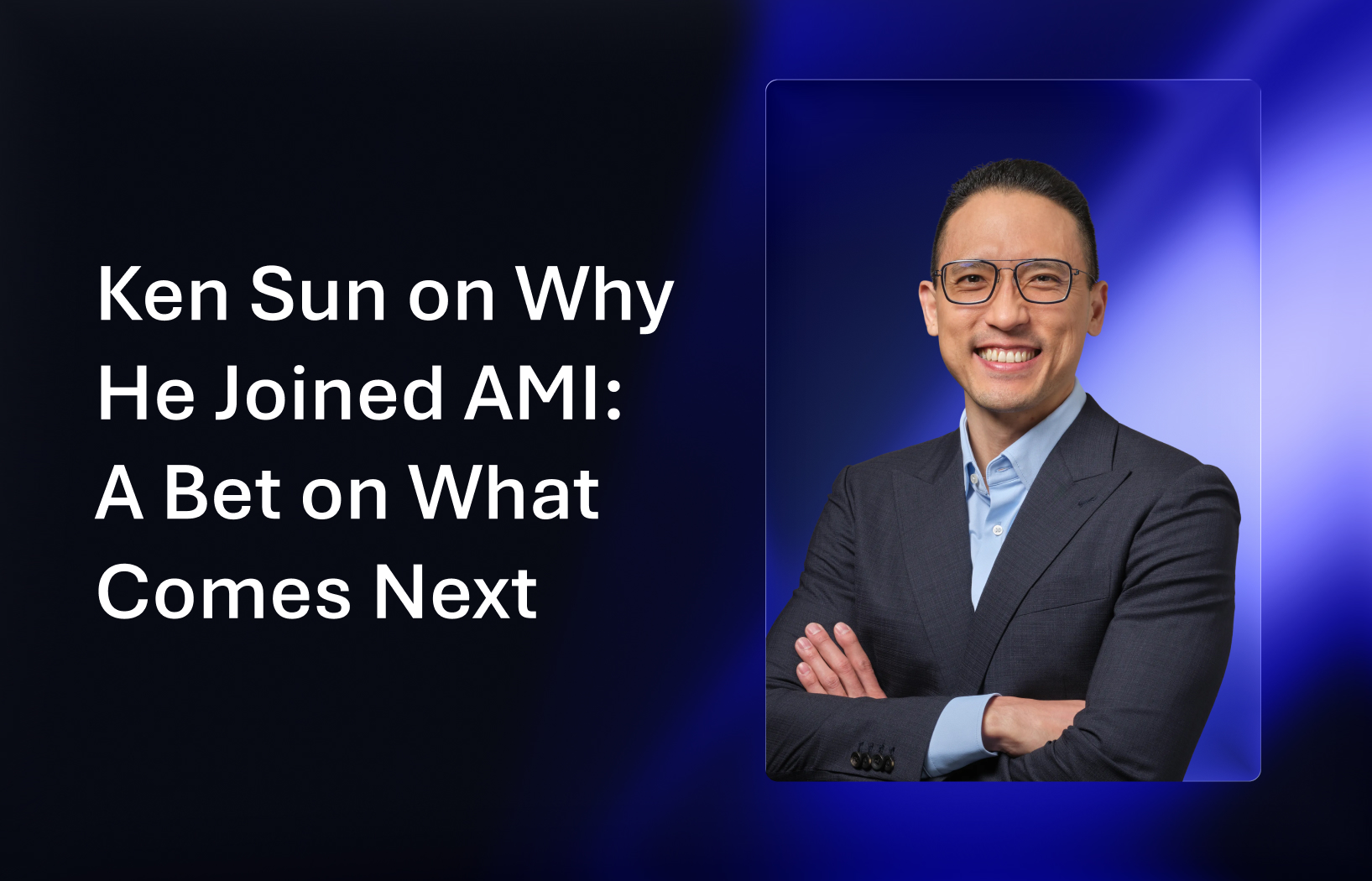
By Ken Sun, Chief Commercial Officer
 AMI Chief Commercial Officer Ken Sun has seen technology waves build and break before. This one’s different. In this post, he explores his belief that the most important work is happening where most people aren’t looking
It’s a big decision to leave one of the world’s most innovative companies, and that’s what I did when I logged my last hours at Microsoft. A lot of folks have asked what drove me to this decision. After all, I had a terrific job working with the industry on important innovation. Here’s my honest answer.
Eight and a half years at Microsoft gave me a front-row seat to cloud transformation. When I joined, we were in the early stages of convincing enterprises that the cloud was real, that it was safe, that it would change how they operated. Watching businesses of every size actually transform because of that shift was genuinely satisfying work. I got to see what it looks like when a technology wave hits critical mass.
And then I watched a new one build.
I’ve been around long enough to have lived through a few of these inflection points. PC to server. On-premise to cloud. Cloud to mobile. Each one has been significant, changing the trajectory. But what’s happening with AI is something else. We’re not automating a process or moving a workload. We’re scaling intelligence itself. That’s a different category of change, and I don’t think we’ve fully absorbed what that means yet.
Most people still think about AI as chatbots and advanced search engines. Useful ones, yes. I use them every day and they make me sharper. My daughters, 15 and 11, are already finding their own ways to work with these tools, and they’re asking hard questions too. About energy consumption. About sustainability. They’re not just users. They’re thinkers. That gives me a lot of hope about where this goes. But the point is: we’re still in the earliest chapter of this story.
And while these use cases are transformative, for enterprise and devops the opportunity is so much richer, and the story to its unfolding is just starting to emerge.
Another truth? The infrastructure to support what’s coming is nowhere near ready. Hyperscalers are deploying $700 billion in data center capex this year alone, and every element of that environment is requiring change. The management of complex systems at this scale is something we’ve never collectively delivered before, and it’s central to achieving AI’s ambition.
That’s where AMI comes in. And that’s why I’m here.
If you map the layers of an AI-driven world, namely power generation and proliferation, cooling, silicon, systems, models, and services, AMI sits in a place that most people outside the heart of infrastructure don’t think about much. Between the silicon and the service, there’s an infrastructure control plane: Firmware. The layer that actually manages how servers boot, how they’re patched, how they’re secured, how they expose who they are to management platforms and talk to everything around them.
In traditional data centers, that layer was important but relatively straightforward. Now? The infrastructure has transformed. We’re not managing individual servers anymore. We’re managing composable workflows on rack-scale compute clusters with integrated power management, liquid cooling, and heterogeneous processors. And here’s a detail that stuck with me from conversations inside Microsoft: operators are sometimes afraid to power down servers for maintenance because there’s a real chance they won’t come back up. That’s the gap between where the infrastructure is and where it needs to be.
AMI is sitting right at that gap. That’s not a problem to avoid. That’s the opportunity.
I also brought something specific to this role that I think matters. My career has moved end to end across the value chain. I’ve worked alongside chip fabs and ODMs in Asia, been on the ground floor for how silicon gets designed and built. I spent years at Schneider Electric, which taught me the operational technology side of data centers: power, cooling, the physical systems that IT people and OT people used to treat as completely separate worlds. Now those worlds are converging, and the solutions for integrated control will come in part from people who can speak both languages.
That convergence is real and it’s accelerating. Firmware now sits across both IT and OT domains simultaneously. Real-time decisions about compute workloads are informed by telemetry from cooling systems. The walls between those disciplines are down, whether everyone’s caught up to that fact or not.
I spent years building relationships across that entire chain. Bringing those connections to AMI, at this particular moment, felt like exactly the right fit.
There’s a version of this story where I talk about vision statements and market positioning. I’ll leave that for another day. What I actually felt, reading about AMI and then talking to the team, was recognition. This is a company that does foundational work. Quiet, critical, foundational work. And the world is about to need that work more than it ever has.