Trusted Platform Module 2.0: A Brief Introduction by Trusted Computing Group

Trusted Platform Module (TPM) 2.0 Brief Introduction

TPM Module 2.0 Brief Introduction.pdf

The Trusted Computing Group (TCG) has been addressing the trust issue – and related security benefits – for PCs, servers, networking gear and embedded systems for more than a decade, driven by the Trusted Platform Module (TPM) specification.

The TPM standard defines a hardware root of trust (HRoT) widely accepted as more secure than software that can be more easily breached by attackers.

The TPM is used with software to enable features; open source APIs are available and custom software can be developed. Additional resources for software support also are provided later in this paper.

In many systems, the TPM provides integrity measurements, health checks and authentication services.

TPM Evolves

While the earlier TPM 1.2 standard was incorporated into billions of PCs, servers, embedded systems, network gear and other devices, the evolving Internet of Things and increasing demand for security beyond traditional PC environment led TCG to develop a new TPM specification, which recently was adopted as an international standard ISO/IEC 11889:2015.

For more flexibility of application and to enable more widespread use of the specification, TCG created TPM 2.0 with a “library” approach. This allows users to choose applicable aspects of TPM functionality for different implementation levels and levels of security. Also, new features and functions were added, such as algorithm agility, the ability to implement new cryptographic algorithms as needed.

Attributes of the TPM Include:

  • Support for bulk (symmetric) encryption in the platform
  • High quality random numbers
  • Cryptographic services
  • A protected persistent store for small amounts of data, sticky- bits, monotonic counters and extendible registers
  • A protected pseudo-persistent store for unlimited amounts of keys and data
  • An extensive choice of authorization methods to access protected keys and data
  • Platform identities
  • Support for platform privacy
  • Signing and verifying digital signatures (normal, anonymous, pseudonymous)
  • Certifying the properties of keys and data
  • Auditing the usage of keys and data

In A Trusted Platform the TPM Also Provides:

  • Attestation: reporting platform state
  • Sealing: using platform state to authorize access to keys and data

A TPM For Many Applications

With TPM 2.0, TCG created a library specification that describes all the commands/features that could be implemented and might be needed in platforms from servers to laptops to embedded systems. Each platform can choose the features needed and the level of security or assurance required. In this way, TPM 2.0 is much more flexible than the original TPM specification. That flexibility allows the newest TPMs to be applied to many embedded applications, including automotive, industrial, smart home and many more – and for designers and developers to select with more granularity the appropriate TPM capabilities for the targeted use case.

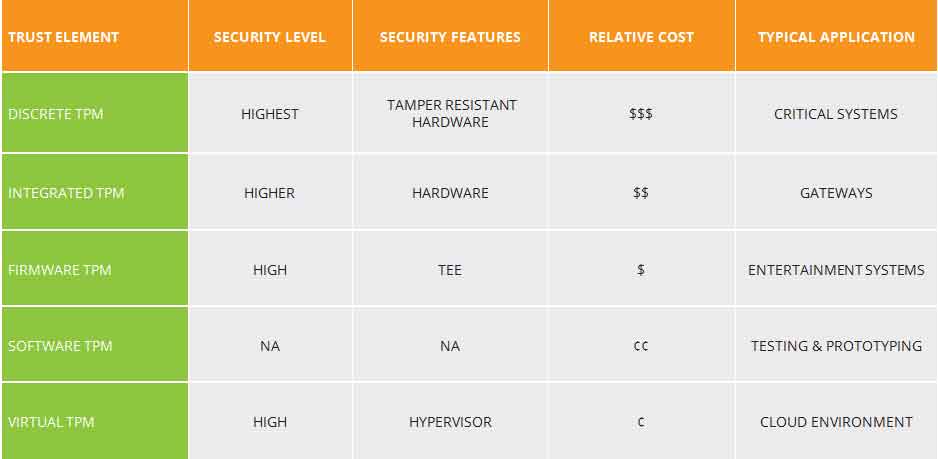
Four types of TPM are popular today, offering different trade-offs between cost, features, and security. TCG continues to evaluate market requirements to further evolve the TPM.

  1. Discrete TPM
    Discrete TPM provides the highest level of security, as might be needed for a TPM used to secure the brake controller in a car. The intent of this level is to ensure that the device it’s protecting does not get hacked via even sophisticated methods. To accomplish this, a discrete chip is designed, built and evaluated for the highest level of security that can resist tampering with the chip, including probing it and freezing it with all sorts of sophisticated attacks.
  2. Integrated TPM
    Integrated TPM is the next level down in terms of security. This level still has a hardware TPM but it is integrated into a chip that provides functions other than security. The hardware implementation makes it resistant to software bugs, however, this level is not designed to be tamper-resistant.
  3. Firmware TPM
    Firmware TPM is implemented in protected software. The code runs on the main CPU, so a separate chip is not required. While running like any other program, the code is in a protected execution environment called a trusted execution environment (TEE) that is separated from the rest of the programs that are running on the CPU. By doing this, secrets like private keys that might be needed by the TPM but should not be accessed by others can be kept in the TEE creating a more difficult path for hackers.
    In addition to the lack of tamper resistance, the downside to the TEE or firmware TPM is that now the TPM is dependent on many additional aspects to keep it secure, including the TEE operating system, bugs in the application code running in the TEE, etc.
  4. Software TPM
    Software TPM can be implemented as a software emulator of the TPM. However, a software TPM is open to many vulnerabilities, not only tampering but also the bugs in any operating system running it. It does have key applications: it is very good for testing or building a system prototype with a TPM in it. For testing purposes, a software TPM could provide the right solution/approach.

Many IoT systems include sensors and cloud processing, which means virtualization. In a cloud environment, one clever way to implement a TPM is through a virtual TPM. The virtual TPM is part of the cloud-based environment and it provides the same commands that a physical TPM would but it provides those commands separately to each virtual machine.

TPM Solutions for Different Needs

The five variations of TPM, discussed roughly in order of security level and decreasing cost, are shown in Table 1. To get a better handle on the cost and security level impact, the TPM supplier needs to be consulted.
TPM Resources

An “open access” book intended to get one started with TPMs:
“A Practical Guide to TPM 2.0 – Using the Trusted Platform Module in the New Age of Security”; Arthur, Challener
https://www.springer.com/us/book/9781430265832

A reference book intended to help explain TPMs:

“Trusted Computing Platforms – TPM2.0 in Context”; Proudler, Chen, Dalton; Springer
https://www.springer.com/us/book/9783319087436

Software

https://sourceforge.net/projects/ibmswtpm2/
https://chromium.googlesource.com/chromiumos/third_party/tpm2/
https://github.com/vbendeb/tpm2_server
https://research.microsoft.com/en-US/downloads/35116857-e544-4003-8e7b-584182dc6833/default.aspx
https://github.com/PeterHuewe/linux-tpmdd/tree/tpm-emulator
https://github.com/PeterHuewe/linux-tpmdd/commit/9329f13c403daf1f4bd1e715d2ba0866e089fb1d
https://github.com/PeterHuewe/linux-tpmdd/commit/bbf2f7064c1452b47f11dfad340326b1205d863a

Trusted for What’s Critical

AMI is your low-risk partner for high-stakes innovation. Our firmware solutions drive performance, reliability and time to market when it matters most.

When you work with AMI, you get deep expertise, proven stability and hands-on support throughout your development journey. Contact us to learn how AMI firmware solutions can help you reduce risk, simplify complexity and scale with confidence.

DOWNLOAD LICENSE AGREEMENT

NOTICE SPECIFIC TO SOFTWARE AVAILABLE ON THIS WEBSITE (ami.com) OR ANY OTHER AMI OWNED, OPERATED, LICENSED OR CONTROLLED SITE

 Any software that is made available to download from this server ("Software") is the copyrighted work of AMI and/or its suppliers. Use of the Software is governed by the terms of the end user license agreement, if any, which accompanies or is included with the Software ("License Agreement"). An end user will be unable to install any Software that is accompanied by or includes a License Agreement, unless he or she first agrees to the License Agreement terms.

 The Software is made available for downloading solely for use by end users according to the License Agreement. Any reproduction or redistribution of the Software not in accordance with the License Agreement is expressly prohibited by law and may result in severe civil and criminal penalties. Violators will be prosecuted to the maximum extent possible.

 WITHOUT LIMITING THE FOREGOING, COPYING OR REPRODUCTION OF THE SOFTWARE TO ANY OTHER SERVER OR LOCATION FOR FURTHER REPRODUCTION OR REDISTRIBUTION IS EXPRESSLY PROHIBITED, UNLESS SUCH REPRODUCTION OR REDISTRIBUTION IS EXPRESSLY PERMITTED BY THE LICENSE AGREEMENT ACCOMPANYING SUCH SOFTWARE.

 THE SOFTWARE IS WARRANTED, IF AT ALL, ONLY ACCORDING TO THE TERMS OF THE LICENSE AGREEMENT. EXCEPT AS WARRANTED IN THE LICENSE AGREEMENT, AMI HEREBY DISCLAIMS ALL WARRANTIES AND CONDITIONS WITH REGARD TO THE SOFTWARE, INCLUDING ALL IMPLIED WARRANTIES AND CONDITIONS OF MERCHANTABILITY, FITNESS FOR A PARTICULAR PURPOSE, TITLE AND NON-INFRINGEMENT.

 FOR YOUR CONVENIENCE, AMI MAY MAKE AVAILABLE ON THIS SERVICE OR IN ITS SOFTWARE PRODUCTS, TOOLS AND UTILITIES FOR USE AND/OR DOWNLOAD. AMI DOES NOT MAKE ANY ASSURANCES WITH REGARD TO THE ACCURACY OF THE RESULTS OR OUTPUT THAT DERIVES FROM SUCH USE OF ANY SUCH TOOLS AND UTILITIES. PLEASE RESPECT THE INTELLECTUAL PROPERTY RIGHTS OF OTHERS WHEN USING THE TOOLS AND UTILITIES MADE AVAILABLE ON THIS SERVICE OR IN AMI SOFTWARE PRODUCTS.

 RESTRICTED RIGHTS LEGEND. Any Software which is downloaded from this Server (ami.com) any other AMI owned, operated, licensed or controlled site for or on behalf of the United States of America, its agencies and/or instrumentalities ("U.S. Government"), is provided with Restricted Rights. Use, duplication, or disclosure by the U.S. Government is subject to restrictions as set forth in subparagraph (c)(1)(ii) of the Rights in Technical Data and Computer Software clause at DFARS 252.227-7013 or subparagraphs (c)(1) and (2) of the Commercial Computer Software - Restricted Rights at 48 CFR 52.227-19, as applicable. Manufacturer is AMI 3095 Satellite Boulevard, Building 800, Suite 425, Duluth, GA 30096.

NOTICE SPECIFIC TO DOCUMENTS AVAILABLE ON THIS WEBSITE

 Permission to use Documents (such as white papers, press releases, datasheets and FAQs) from this server (ami.com) any other AMI owned, operated, licensed or controlled site ("Server") is granted, provided that (1) the below copyright notice appears in all copies and that both the copyright notice and this permission notice appear, (2) use of such Documents from this Server is for informational and non-commercial or personal use only and will not be copied or posted on any network computer or broadcast in any media and (3) no modifications of any Documents are made. Educational institutions ( specifically K-12, universities and state community colleges) may download and reproduce the Documents for distribution in the classroom. Distribution outside the classroom requires express written permission. Use for any other purpose is expressly prohibited by law and may result in severe civil and criminal penalties. Violators will be prosecuted to the maximum extent possible.

 Documents specified above do not include the design or layout of the ami.com website or any other AMI owned, operated, licensed or controlled site. Elements of AMI websites are protected by trade dress, trademark, unfair competition and other laws and may not be copied or imitated in whole or in part. No logo, graphic, sound or image from any AMI website may be copied or retransmitted unless expressly permitted by AMI.

 AMI AND/OR ITS RESPECTIVE SUPPLIERS MAKE NO REPRESENTATIONS ABOUT THE SUITABILITY OF THE INFORMATION CONTAINED IN THE DOCUMENTS AND RELATED GRAPHICS PUBLISHED ON THIS SERVER FOR ANY PURPOSE. ALL SUCH DOCUMENTS AND RELATED GRAPHICS ARE PROVIDED "AS IS" WITHOUT WARRANTY OF ANY KIND. AMI AND/OR ITS RESPECTIVE SUPPLIERS HEREBY DISCLAIM ALL WARRANTIES AND CONDITIONS WITH REGARD TO THIS INFORMATION, INCLUDING ALL IMPLIED WARRANTIES AND CONDITIONS OF MERCHANTABILITY, FITNESS FOR A PARTICULAR PURPOSE, TITLE AND NON-INFRINGEMENT. IN NO EVENT SHALL AMI AND/OR ITS RESPECTIVE SUPPLIERS BE LIABLE FOR ANY SPECIAL, INDIRECT OR CONSEQUENTIAL DAMAGES OR ANY DAMAGES WHATSOEVER RESULTING FROM LOSS OF USE, DATA OR PROFITS, WHETHER IN AN ACTION OF CONTRACT, NEGLIGENCE OR OTHER TORTIOUS ACTION, ARISING OUT OF OR IN CONNECTION WITH THE USE OR PERFORMANCE OF INFORMATION AVAILABLE FROM THIS SERVER.

 THE DOCUMENTS AND RELATED GRAPHICS PUBLISHED ON THIS SERVER COULD INCLUDE TECHNICAL INACCURACIES OR TYPOGRAPHICAL ERRORS. CHANGES ARE PERIODICALLY ADDED TO THE INFORMATION HEREIN. AMI AND/OR ITS RESPECTIVE SUPPLIERS MAY MAKE IMPROVEMENTS AND/OR CHANGES IN THE PRODUCT(S) AND/OR THE PROGRAM(S) DESCRIBED HEREIN AT ANY TIME.

NOTICES AND PROCEDURE FOR MAKING CLAIMS OF COPYRIGHT INFRINGEMENT

 Pursuant to Title 17, United States Code, Section 512(c)(2), notifications of claimed copyright infringement should be sent to Service Provider's Designated Agent. ALL INQUIRIES NOT RELEVANT TO THE FOLLOWING PROCEDURE WILL NOT RECEIVE A RESPONSE.

 See Notice and Procedure for Making Claims of Copyright Infringement.

LINKS TO THIRD PARTY SITES

 THE LINKS IN THIS AREA WILL LET YOU LEAVE AMI'S SITE. THE LINKED SITES ARE NOT UNDER THE CONTROL OF AMI AND AMI IS NOT RESPONSIBLE FOR THE CONTENTS OF ANY LINKED SITE OR ANY LINK CONTAINED IN A LINKED SITE, OR ANY CHANGES OR UPDATES TO SUCH SITES. AMI IS NOT RESPONSIBLE FOR WEBCASTING OR ANY OTHER FORM OF TRANSMISSION RECEIVED FROM ANY LINKED SITE. AMI IS PROVIDING THESE LINKS TO YOU ONLY AS A CONVENIENCE, AND THE INCLUSION OF ANY LINK DOES NOT IMPLY ENDORSEMENT BY AMI OF THE SITE.

UNSOLICITED IDEA SUBMISSION POLICY

 Neither AMI, nor its employees, agents and/or subsidiaries, shall accept or consider unsolicited ideas, including but not limited to ideas for new advertising campaigns, new promotions, new products or technologies, processes, materials, marketing plans or new product names. Submission of any original creative artwork, samples, demos, or other works to AMI is expressly prohibited. In the event a submission including unsolicited materials of any nature is received by AMI, said submission shall be destroyed and AMI shall not be liable for any direct or consequential damages suffered by the sender, nor shall AMI be under any obligation to treat such material as confidential or proprietary. It is expressly understood that the rationale for AMI's policy on unsolicited idea submission is to prevent a third party from making a claim of infringement against AMI on the basis of an idea, product, or other material that is developed by AMI, that may be similar to or the same as an idea, product, or other material contained in an unsolicited submission that may have been submitted to and/or received by AMI.

FEEDBACK AND INFORMATION

 ANY FEEDBACK YOU PROVIDE AT THIS SITE SHALL BE DEEMED TO BE NON-CONFIDENTIAL. AMI IS FREE TO USE SUCH INFORMATION ON AN UNRESTRICTED BASIS.

Terms & Conditions